


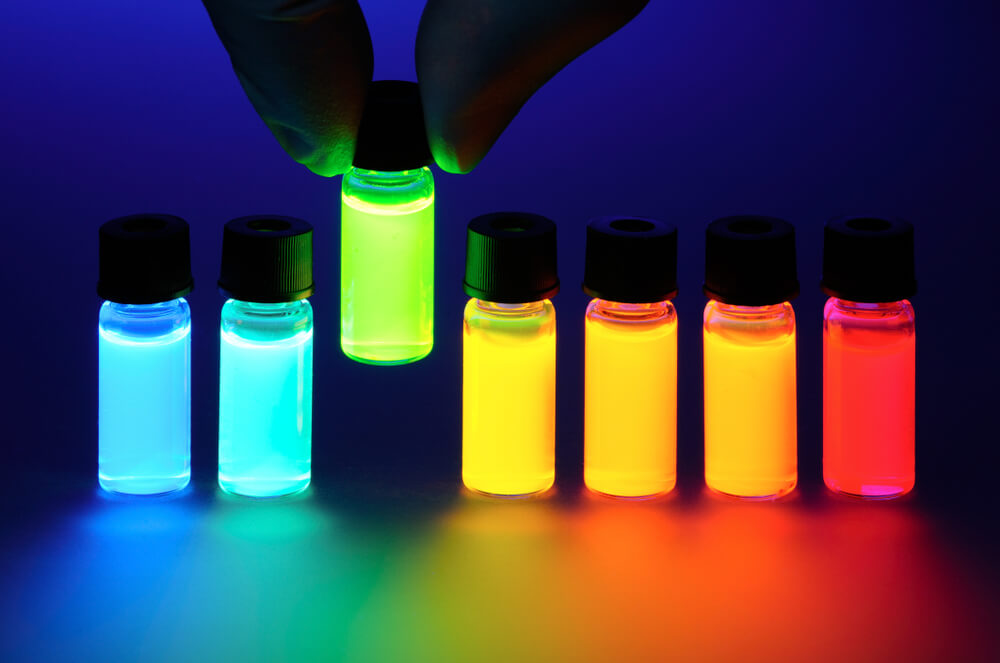
Fluorescence is the rapid emission of light by a substance that has absorbed electromagnetic radiation, typically occurring within nanoseconds as excited electrons return to their ground state. The unique properties of fluorescent light help power Angstrom Technologies Inc.’s advanced authentication and security solutions for a range of industries.
For security printing applications, understanding the relationship between absorption, excitation, and emission wavelengths enables the design of invisible fluorescent inks that deliver reliable, field-ready authentication with minimal equipment and maximum signal clarity.
Key Fluorescence Concepts at a Glance
What Are Fluorophores?
- Fluorophores are molecules that can fluoresce, including organic dyes, inorganic compounds, and engineered pigments.
- Each exhibits a unique absorption and emission spectrum, acting as a molecular fingerprint for secure marking and detection.
Absorption vs. Excitation
- Absorption spectrum: Shows all wavelengths absorbed by a fluorophore.
- Excitation spectrum: Identifies wavelengths most effective at triggering fluorescence; often closely matches the absorption spectrum with minor differences revealing unique photophysical traits.
Emission and the Stokes Shift
- Emission describes light emitted as excited electrons return to a lower energy state.
- The emitted light (fluorescence) appears at longer wavelengths (lower energy) than the absorbed light—this is known as the Stokes shift, enabling distinct separation between excitation and emission signals for reliable authentication.

Absorption and Excitation: Capturing Energy
The absorption spectrum reveals which wavelengths a fluorophore captures most efficiently. When UV or visible light strikes fluorescent molecules, photons matching specific energy transitions promote electrons from ground states to excited states. Strong absorption bands indicate wavelengths where photon capture is most probable.
Measuring absorption is straightforward: shine light through a sample and quantify how much each wavelength is attenuated. The resulting spectrum shows peaks at wavelengths where the fluorophore absorbs strongly and valleys where transmission is high.
The excitation spectrum takes a different approach: hold emission detection at a fixed wavelength and scan through excitation wavelengths, measuring which produce the strongest fluorescence. This spectrum typically mirrors the absorption spectrum because wavelengths absorbed efficiently generally produce efficient fluorescence.
What’s the Difference?
Multiple chromophores in a mixture may absorb at similar wavelengths but emit differently. Some absorbed energy may dissipate through non-radiative pathways rather than fluorescence. For practical security applications, excitation spectra guide optimal light source selection—identifying which wavelengths deliver maximum fluorescent signal for field verification.
Practical consideration: Choose excitation wavelengths that maximize target fluorophore response while minimizing interference from substrate fluorescence, ambient lighting, and optical brighteners commonly found in papers and plastics.

Emission and Stokes Shift: The Fluorescent Signature
After absorbing high-energy photons, excited electrons quickly lose small amounts of energy through molecular vibrations before emitting the remaining energy as light. This energy loss ensures emitted photons have longer wavelengths than absorbed photons—the Stokes shift.
The emission spectrum displays the distribution of wavelengths released during fluorescence. For most organic fluorophores, emission peaks occur 20-100 nanometers longer than absorption peaks. This predictable shift is what makes fluorescence detection practical: excitation light can be filtered out optically, leaving only the shifted emission signal for detection.
The Impact of Stokes Shift on Detection
Larger Stokes shifts improve detection quality by creating clearer separation between excitation and emission. When peaks are well-separated, optical filters can block excitation light completely while passing emission wavelengths efficiently, reducing background noise and false signals.
Practical consideration: UV handheld detectors use specific filter combinations matched to fluorophore emission characteristics. A detector optimized for 254nm excitation with 450nm emission won’t perform well with fluorophores emitting at 550nm. Matching detector optics to pigment specifications ensures consistent read rates across inspection environments.
Real-World Fluorescence Performance Factors
- Quantum yield: Measures fluorescence efficiency, or the ratio of photons emitted to photons absorbed. High quantum yield fluorophores convert absorbed light into bright fluorescence, enabling detection at lower concentrations and improving read reliability under suboptimal lighting.
- Extinction coefficient: Quantifies how strongly a fluorophore absorbs at specific wavelengths. High extinction coefficients mean more light capture per molecule, contributing to overall brightness.
Together, quantum yield and extinction coefficient determine practical fluorescence intensity. Spectral overlap between excitation and emission can complicate detection when Stokes shifts are small.
Proper optical filtering is essential. Excitation filters pass only desired UV wavelengths to the sample, while emission filters block excitation light and pass only fluorescent wavelengths to the detector.

Fluorescence Applications in Security Printing
Invisible fluorescent inks leverage these photophysical principles to create covert authentication features. Under normal lighting, these inks remain completely undetectable—absorption occurs in the UV range invisible to human eyes, and no visible light is emitted without UV excitation. When illuminated with UV sources, characteristic emission colors appear instantly, providing rapid pass-fail authentication.
Tax stamps, identity documents, product labels, and pharmaceutical packaging incorporate invisible fluorescent features as primary or secondary authentication layers. The covert nature prevents counterfeiters from identifying and targeting security elements through visual inspection.
A Multi-Wavelength Approach
Shortwave UV (254nm) excitation produces different fluorescent responses than longwave UV (365nm) for the same material, or separate fluorophores can be formulated to respond exclusively to specific wavelengths.
Layering multiple fluorescent features with distinct excitation-emission profiles creates authentication systems requiring multiple verification steps to fully decode.
Fluorescence FAQs
Both measure the same fundamental property—which wavelengths the fluorophore captures—using different detection methods. Absorption measures light removal; excitation measures fluorescence production.
Once excited, electrons quickly relax to the lowest excited state through rapid vibrational energy loss before emitting light. Regardless of which higher state was initially populated, emission occurs from the same lowest excited state, producing consistent emission spectra.
True fluorescence ceases within nanoseconds of removing excitation. Persistent glow indicates phosphorescence, an entirely different process unsuitable for rapid authentication.
Explore Custom Fluorescence Solutions With Angstrom Technologies Inc.
Want to explore fluorescence solutions for your business? Reach out today to learn how we customize solutions to meet your application needs.